Objects of Desire
A choir with no instruments: how Bali sounds
The gamelan’s bronze, the Kecak’s chanting circle, and where to hear both on Bali.

Photo Credit
Image courtesy of © Saranabhi · CC BY-SA 3.0 via Wikimedia CommonsMost islands are heard as surf. Bali is heard as bronze: the gamelan at a temple festival, and the cak-cak-cak of the Kecak at Uluwatu as the sun goes down. What makes the island sound like nowhere else, and where can a visitor listen properly? UNESCO’s citations, the temple’s own pages and the venues that keep the music alive answer, checked in November 2026.
An orchestra of hammered bronze
UNESCO describes gamelan as Indonesia’s traditional percussion orchestra, and as the instruments themselves: mostly ornate percussion of hand-forged metal, with xylophones, gongs, gong-chimes, drums, cymbals, strings and bamboo flutes. It inscribed gamelan on its list of intangible heritage in 2021, noting evidence of the music carved into the reliefs of the eighth-century Borobudur temple, on Java.
The trick of the sound is cooperation. A melody is played by several instruments at once, and players split a rhythm into interlocking parts that only make sense together, so no single musician ever holds the whole tune. It is a democratic arrangement, and a loud one: UNESCO notes that men, women and children of all ages play, at rituals, ceremonies, theatre, festivals and concerts.
The craft runs deeper than the players. UNESCO counts vocalists and instrumentalists among the practitioners, but also the instrument-makers and the tuners, and notes that gamelan is used for music therapy and seen as a way of connecting people with the universe. An orchestra that needs its own blacksmiths is not a hobby; it is an institution.
Dance, the visible half of the music
In 2015 UNESCO added three genres of traditional Balinese dance: the sacred, the semi-sacred and dances for the enjoyment of the whole community. Its citation describes cloth painted with gold, gold-leafed accessories and a basic posture with the knees turned out and the stomach held in. Technique is not enough, it adds: dancers need charisma, humility and discipline too.
Most children learn informally, in groups, from an early age, repeating the movements until the sequence is memorised. You can watch that apprenticeship in Sanur. The Tandjung Sari Foundation, set up by the hotel in September 1987 to keep classical dance alive, teaches children from the local banjar on Friday and Sunday afternoons, and they perform on the first and third Saturday evenings of each month.
In Ubud, the Sacred Monkey Forest Sanctuary has a stage beside its Wana Café with Balinese dance every Saturday and Sunday at 11am and 4pm, coffee to hand. Its repertoire includes the Lubdaka, a dance from the nearby village of Petulu. The audience in the trees has never once bought a ticket.
No single musician ever holds the whole tune.
The choir at the edge of the cliff
The Kecak has no gamelan at all. The temple’s managing body says it was developed in the 1930s by the Balinese artist Wayan Limbak with Walter Spies, a German painter and musician, who adapted the sacred Sanghyang trance dance into a drama from the Ramayana. The orchestra is a large male chorus, and the instrument is its chant: cak-cak-cak, over and over, until the air itself seems to keep time.
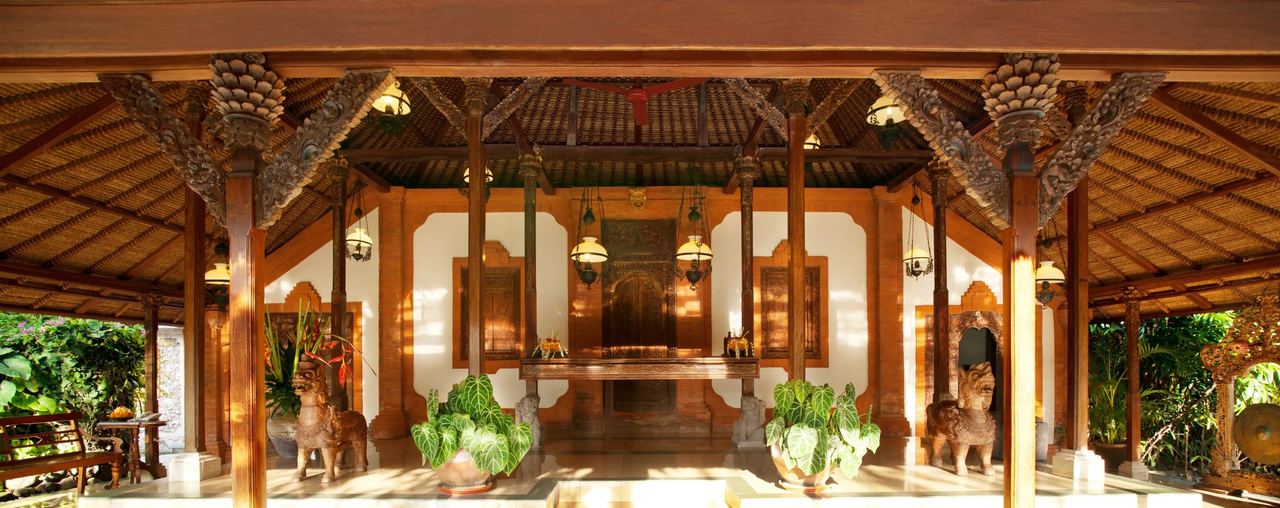
Photo Credit
Image courtesy of © Tandjung SariThe temple explains the staging too. The chanting men sit in a circle, which stands for unity and spiritual protection, and the fire used in the performance is believed to purify and protect. The story is the abduction of Shinta, wife of Prince Rama, by the demon king Rahwana, and the battle to bring her home.
At Pura Luhur Uluwatu the circle sits in an amphitheatre on a cliff about 70 metres above the Indian Ocean, with the sun going down behind it. The story climbs to Hanoman’s fire dance, in which Hanoman, the white monkey warrior, sets Rahwana’s palace alight. Given the temple’s resident macaques and their interest in sunglasses, the monkey on stage is often the best-behaved one present.
The Kecak runs every evening from 6pm to 7pm; the gate opens at 4pm, and the temple suggests arriving at least an hour early, with the best seats going to those who come before 5pm. Tickets are IDR 150,000 for adults and IDR 75,000 for children aged 2 to 9 at the official booth by the temple entrance, generally in cash, and separate from the temple’s own entrance fee. The seats are stone.
Our advice: hear Bali’s music twice. Take the Kecak at Uluwatu for theatre, with a cushion and exact change, and a Saturday evening in Sanur or a weekend afternoon in Ubud for dancers and gamelan at close range. At a temple festival, remember that the music was never a performance for you; sit still, and the courtesy shows.
Why it's on our list
- An orchestra of hammered bronze
- Dance, the visible half
- The choir at the cliff edge
- Tickets and timing
Location
The map comes from Google Maps, which sets its own cookies once it loads.
More in depth
 Objects of DesireThatch, terracotta and a stone tiger: how Bali buildsFrom four bungalows in Sanur to 1.8 million hand-pressed bricks: Bali’s standout buildings.
 Objects of DesireSundown, with a footnote: Bali and the Mai-TaiThe IBA’s Mai-Tai, a cliff-foot bar with 880 seats, upcycled citrus and a 1930s speakeasy.
 Objects of DesireLess parked than crouched: the electric Jaguar and the new supercarsJaguar’s Type 00 and Type 01, Ferrari’s first electric car and the record-breakers around them.